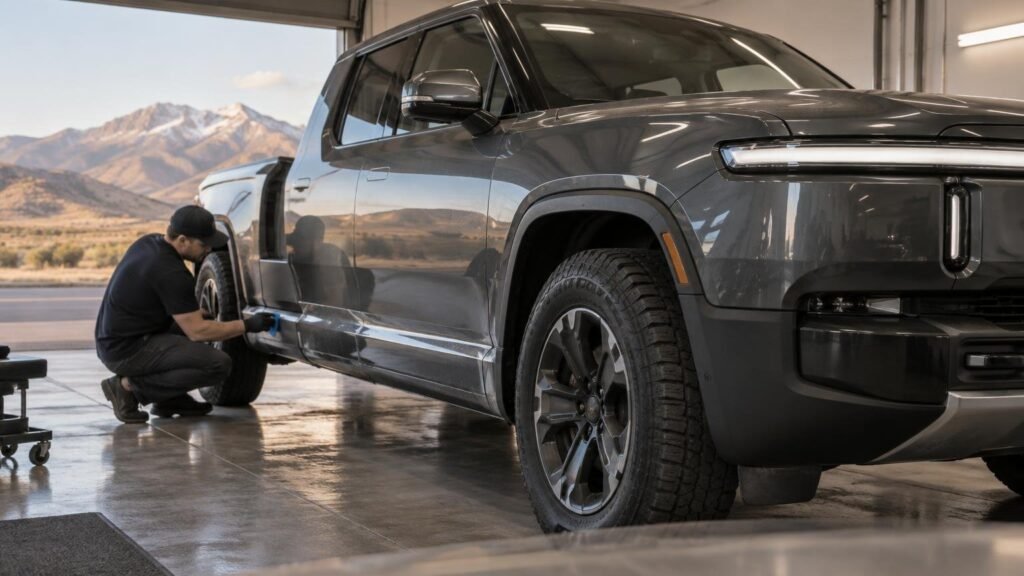
For most Rivian R1T PPF Utah decisions, full-front coverage is the practical starting point, while rocker panels, lower doors, gear-tunnel-adjacent areas, door edges, and loading zones should be added according to actual exposure. Full-vehicle film can make sense for an owner who wants consistent coverage or a satin finish, but it is not automatically the best value for every truck.
The useful question is not simply how much film fits the budget. It is which painted panels face repeated road debris, cargo contact, brush, boots, skis, bikes, or trail use. The answer changes with freeway mileage, winter canyon travel, gravel roads, off-road use, ownership horizon, paint condition, and tolerance for visible seams.
Why R1T coverage needs a panel-by-panel plan
The R1T is a large truck with multiple access and loading areas. Rivian lists it at 217.1 inches long and 82 inches wide with the mirrors folded, although owners should confirm specifications for their particular model year and configuration on Rivian’s current model comparison page. Its scale and panel layout mean that a package name alone does not tell you enough about the installation.
“Full front,” for example, commonly refers to the full hood, front fenders, front bumper, and mirror caps in Wasatch PPF’s published service language. Another installer may define the term differently or exclude a difficult surface. A useful quote should identify every included panel, whether edges will be wrapped where practical, where seams may remain, and which trim or textured surfaces are excluded.
The gear-tunnel area deserves the same precision. Ask the installer to inspect the doors, painted perimeter, lower body, sills, and nearby contact zones rather than requesting generic “gear-tunnel PPF.” Surface material, edge geometry, existing wear, accessories, and the way the tunnel is loaded can affect whether film is appropriate and where it should end.
Rivian R1T PPF Utah coverage options
| Coverage choice | Typical discussion areas | Best fit |
|---|---|---|
| Partial front | Front bumper and a portion of the hood and fenders; exact boundaries vary | Lower-mileage owners prioritizing the leading impact zones and accepting visible film lines |
| Full front | Full hood, front fenders, front bumper, and mirrors when confirmed in the quote | Frequent freeway, canyon, or road-trip driving where front-end exposure is the main concern |
| High-impact additions | Rockers, lower doors, door edges and cups, sills, loading zones, and inspected gear-tunnel-adjacent surfaces | Trucks used for winter travel, gravel roads, outdoor equipment, pets, work, towing, or recreation |
| Full vehicle | Eligible painted exterior panels, with exclusions documented before installation | Owners prioritizing broad coverage, consistent film appearance, or a full satin-look conversion |
Partial-front coverage
A partial-front package concentrates the budget on forward-facing surfaces. It can be reasonable for an R1T driven mainly around town or for an owner comfortable accepting some exposed paint. Its main visual compromise is the film line across the hood and possibly the fenders. That line may be subtle on some colors and more noticeable when dust, wax residue, or road grime gathers along it.
Full-front coverage
Full-front PPF removes the mid-panel hood and fender seams associated with many partial packages. It is often the strongest starting point for an R1T that spends substantial time on I-15, canyon routes, or long highway trips. It still leaves the doors, bedsides, rockers, and rear loading areas exposed, so “full front” should not be mistaken for comprehensive truck coverage.
Rockers and lower-door areas
Rocker and lower-door coverage becomes more compelling when the truck regularly encounters gravel, construction debris, winter buildup, or unpaved access roads. These areas also face contamination kicked up by the tires. Coverage boundaries should follow the R1T’s panel geometry cleanly and avoid creating awkward exposed strips. Owners comparing this upgrade can use the broader Utah rocker-panel PPF decision guide to weigh lower-body exposure against front-end priorities.
Gear-tunnel, sill, and loading-contact zones
Protection around frequently used openings is less about high-speed impacts and more about repeated contact. Boots, buckles, bins, straps, outdoor equipment, and pet claws can brush painted edges and adjacent panels. Film may be useful on eligible painted contact zones, but the installer should first identify which surfaces are painted, textured, repaired, coated, or unsuitable for adhesion.
The same logic applies to door cups, door edges, bed-access points, and any painted area contacted while loading bikes or ski equipment. Targeted pieces can offer better value than wrapping a whole side of the truck when the risk is concentrated in a few predictable locations. Owners who use roof boxes or carry winter equipment may also benefit from the ski-trip loading-area protection guide.
Full-vehicle and satin-look film
Full-vehicle PPF provides the broadest eligible painted-panel coverage and can reduce the visual inconsistency between protected and unprotected areas. Rivian’s XPEL collaboration lists full-vehicle, front, rocker-panel, and door-sill coverage categories. It also presents XPEL STEALTH as a full-vehicle satin-look option. Those offerings do not establish what a particular Utah installer stocks, so confirm the exact product and availability in writing.
A satin conversion requires particular attention to coverage consistency. Leaving a glossy painted panel exposed can create an obvious finish mismatch. Repairs can also involve replacing film on an entire panel to preserve an even appearance. Clear glossy film is generally more forgiving when an owner wants targeted protection rather than a complete visual transformation.
Match coverage to how the truck is used
A highway commuter usually benefits first from front-end coverage. A truck used for ski trips may add rockers, lower doors, sills, and equipment-loading areas. Gravel-road and off-road use can justify broader lower-body protection, but film cannot prevent dents, deep gouges, or damage from every impact. PPF reduces risk to the covered paint; it does not make the R1T invulnerable.
Utah winter maintenance also matters. The Utah Department of Transportation snow-removal guidance says crews may use salt brine before storms and salt, de-slicking grit, or volcanic cinders during applicable storm conditions. That mixture makes regular cleaning valuable whether or not the truck has PPF. Film covers selected painted surfaces, not the underbody, suspension, brakes, seams, or every place where road buildup can collect. The Utah road-treatment and PPF guide explains why coverage and cleaning solve different problems.
Inspect the R1T before choosing a package
Film follows the surface beneath it. It does not hide chips, deep scratches, poor touch-up work, or uneven repainting. Before quoting the job, an installer should inspect the truck under useful lighting and document anything that could affect appearance, adhesion, or future removal.
- Confirm the model year, generation, paint color, finish, and relevant exterior options.
- Identify chips, scratches, stains, touch-up paint, dents, and paint defects before film is applied.
- Disclose repainted or repaired panels. Removal risk can differ from sound factory paint.
- Identify existing PPF, vinyl, ceramic coating, sealants, or unknown surface treatments.
- Review accessories, running boards, mud flaps, racks, tonneau equipment, and other parts that may affect access or coverage.
- Explain wheel and tire changes that may alter debris exposure along the lower body.
- Describe freeway mileage, winter canyon trips, gravel-road use, off-road driving, towing, work duties, and loading habits.
- Inspect gear-tunnel-adjacent surfaces, sills, trim transitions, and edges for material and adhesion compatibility.
An existing ceramic coating requires special attention because PPF needs properly prepared paint for reliable adhesion. The installer should determine what is on the surface and specify the preparation rather than assuming film can be applied directly over it.
Keep PPF, coatings, and wraps distinct
PPF is primarily a physical barrier against abrasion and road debris. Ceramic coating changes surface behavior and can make washing easier, but it is not a substitute for impact-protection film. Vinyl wrap is primarily an appearance and graphics material. Color PPF combines a visual change with PPF-style physical protection, although its exact properties depend on the named product.
For an owner who wants a different color, the decision should compare color PPF with vinyl wrap rather than treating all vehicle films as interchangeable. The color PPF versus vinyl wrap comparison explains the protection, finish, coverage, and replacement tradeoffs.
What to require in the film and warranty paperwork
Ask for the manufacturer and exact product line, not just a general statement that the film is premium or self-healing. Rivian describes XPEL ULTIMATE PLUS in its collaboration materials as an 8-mil gloss film and relays manufacturer claims concerning scratches, UV yellowing, wear, and a topcoat that self-heals in sunlight. Those claims apply to that named product, not automatically to another film or installation.
XPEL publishes a ten-year warranty for specified ULTIMATE PLUS and STEALTH manufacturing defects, including yellowing, cracking, blistering, and delamination. Its published exclusions include physical paint damage and certain wash-related damage and water spots. That warranty is relevant only if the quoted product is covered and all eligibility requirements are met. Obtain the current written warranty rather than relying on a verbal summary.
- Exact film manufacturer, product line, finish, and documented thickness
- Panel-by-panel coverage and all excluded surfaces
- Preparation, disassembly, correction, and touch-up responsibilities
- Expected seam locations and which edges will be wrapped where practical
- Treatment of emblems, sensors, trim, access doors, and accessories
- Manufacturer and installer warranty documents, eligibility requirements, and exclusions
- Estimated installation time and any initial curing restrictions
- Product-specific washing, stain-removal, repair, and replacement instructions
Plan post-install washing before winter or trail use
Follow the selected film manufacturer’s instructions and the owner’s guide for the truck’s model year. The supplied Rivian guide for specified 2022–2024 vehicles advises washing before dirt accumulates, avoiding direct sun and hot water, and rinsing road buildup from the underbody, fenders, brakes, and wheel wells. For pressure washing, it specifies a sweeping motion, no more than 1,100 psi, at least a 25-degree spray angle, and a minimum distance of 15 inches. Verify those limits against the applicable current guide and the film maker’s instructions before using them on a particular R1T.
Avoid concentrating pressure at film edges, seams, or damaged areas. If an edge lifts or a section is cut by debris, have it assessed rather than trying to seal it with an unapproved chemical. A damaged section can sometimes be replaced panel by panel, which is another reason to document the installed product and retain the warranty paperwork.
Request a precise R1T quote
For many Utah R1T owners, the balanced choice will be full-front PPF plus selected rocker, lower-door, sill, gear-tunnel-adjacent, or loading-area pieces. Choose full-vehicle coverage when broad protection or a consistent satin appearance justifies the added scope. Choose less when the truck’s exposure is modest and the extra covered area would mostly add cost.