TLDR: For PPF ski trips Utah drivers should protect two different kinds of exposure: road-facing panels that encounter debris and gear-facing areas that get rubbed during loading. Frequent canyon drivers will often get the most practical value from full-front PPF, followed by rocker or lower-panel coverage and a rear loading-lip strip. Door cups, sills, roof-rack contact areas, and other small zones should be added only when the vehicle’s shape and actual loading routine justify them. Full-body PPF is an option, not the default.
Ski travel does not expose every painted panel equally. The front bumper, hood, fenders, mirror caps, lower sides, and areas behind the wheels face road exposure. The rear bumper ledge, door openings, roof edges, and rack-adjacent paint face a different problem: boots, bindings, bags, buckles, and repeated reaching over the vehicle. A good plan separates these risks instead of buying the largest coverage package automatically.
Why Utah ski trips create two kinds of paint exposure
The first category is driving exposure. Freeway and canyon mileage puts the front of the vehicle in the path of airborne road debris. Depending on the vehicle’s shape, the rocker panels, lower doors, and rear-quarter areas may also receive material thrown by the tires. PPF can reduce the chance of chips and abrasion on covered paint, but a hard enough impact can still damage the film or the finish beneath it.
Winter road treatment adds a maintenance concern. UDOT says its operations may use salt brine before storms and materials including salt, grit, volcanic cinders, and, in some locations, potassium acetate during storms. Drivers can review UDOT’s explanation of Utah snow-removal materials and practices. Film over a painted panel does not eliminate the need to wash road residue from the vehicle, wheel wells, seams, and underbody.
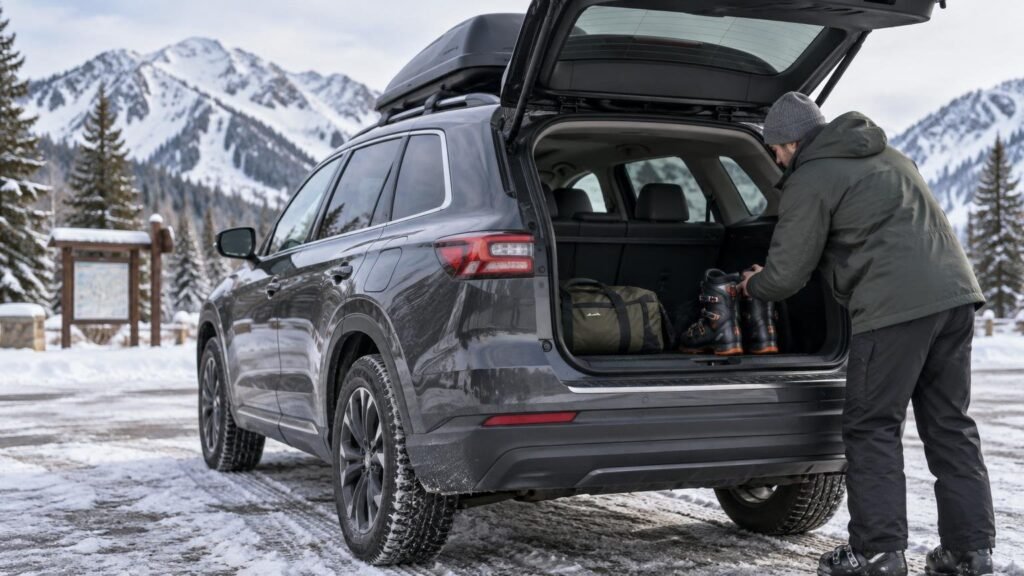
The second category is contact wear. A ski bag dragged over a rear bumper, a boot buckle brushing a sill, or a roof-box strap rubbing a painted edge creates localized abrasion rather than a front-end impact. These small zones are where targeted pieces may accomplish more than adding film to a large panel that rarely encounters gear.
Start PPF ski trips Utah coverage at the front
For regular ski travel, front-end coverage is usually the first decision. Wasatch PPF describes partial-front, full-front, targeted high-impact, and full-vehicle options, with the appropriate package depending on the vehicle and its use. The choice between partial-front and full-front coverage comes down to mileage, appearance preferences, panel geometry, ownership horizon, and budget.
When partial-front coverage can be enough
Partial-front PPF can be reasonable for an occasional skier who makes only a few winter trips, drives modest annual mileage, or wants to limit spending. It commonly concentrates protection on the front bumper and leading portions of other front panels, although exact coverage should be confirmed before installation.
The tradeoff is that a film edge may cross the hood or fenders. That line can become more noticeable when the vehicle is dirty, viewed under angled light, or finished in a color that makes surface transitions easy to see. Ask where every edge will sit rather than relying only on a package name. This guide to normal PPF seams and placement questions explains why panel shape and agreed coverage matter.
When full-front coverage makes more sense
Full-front PPF generally becomes more compelling for frequent weekend canyon drivers, high-mileage commuters who also ski, and owners who strongly prefer not to see partial-panel seams. It typically protects complete front-facing painted panels rather than stopping partway across them. Confirm the included panels because “full front” can be defined differently by different installers.
A sensible quote should identify treatment of the bumper, hood, fenders, mirror caps, headlights if applicable, and any painted trim or unusual front geometry. Film cannot cover grilles, radiators, windshields, sensors, or every recessed surface in the same way it covers painted sheet metal.
Add lower-body coverage when the vehicle throws debris onto itself
Rocker panels and lower doors should not be automatic additions for every ski vehicle. They become more relevant when the tires sit flush with or outside the body, the vehicle has wide lower quarters, the factory mud flaps provide limited interception, or regular travel includes gritty shoulders and debris-covered access roads.
Look for the actual exposure pattern after several winter drives. Dirt concentrated behind the front wheels, along the rocker, or ahead of the rear wheel opening is a useful clue about where the vehicle directs spray and grit. Existing pitting in those areas also matters, although film will not reverse damage already present.
Coverage can include the rocker panels alone, the lower doors, areas behind the wheels, or a combination shaped around the body. The right boundary should account for visible seams and the transition between painted metal and textured cladding. The detailed rocker-panel PPF guide for Utah winter driving can help determine whether this should follow front-end coverage in your budget.
Protect the places where skis, boots, and luggage touch
Loading-area film is often a small, efficient upgrade because the contact pattern is predictable. The key is to watch how the vehicle is actually packed rather than trying to protect every surface that could theoretically be touched.
- Rear bumper loading ledge: Useful when ski bags, boards, boot bins, coolers, or luggage regularly slide across a painted horizontal surface.
- Cargo-opening edge: Worth considering where long gear passes close to painted metal around the hatch opening.
- Door cups: Helps with repeated fingernail, ring, and glove contact behind exterior handles.
- Door edges: Relevant when doors are frequently opened in tight garages or parking spaces, although film cannot prevent dents from a substantial strike.
- Painted door sills: Useful when bulky winter boots regularly brush exposed paint. Plastic or textured trim may need a different approach.
- Lower hatch area: Consider it when straps, buckles, or bags repeatedly rest against the exterior while the cargo area is being organized.
Film placement should follow the contact path. A narrow strip in the correct place may be more valuable than a larger piece installed beside the area where bindings and bags actually land.
Roof boxes and racks require a contact-point inspection
A roof box does not automatically mean the whole roof needs PPF. Start by identifying how the system mounts and where gear passes during loading. Possible concern areas include painted roof edges reached over from the side, small zones near removable rack feet, and pillars or upper doors brushed by clothing, buckles, or ski bags.
Do not assume film should simply be placed beneath every rack foot or clamp. Mounting hardware applies load, and compatibility depends on the rack design, accessory instructions, film edge placement, and whether the system moves or is removed seasonally. Ask the installer and rack manufacturer how the contact point should be handled. Dirt trapped around a removable component should be cleaned carefully instead of allowed to grind against adjacent paint.
If the box stays installed all winter but is removed in spring, inspect the roof after removal and before reinstalling it. If loading causes contact several inches away from the feet, protect that repeatable contact zone rather than focusing exclusively on the mounts.
Match the package to your ski-driver profile
| Driver profile | Practical starting point | Consider adding |
|---|---|---|
| A few ski days per season | Partial-front coverage or selected front impact areas | Rear loading ledge if gear is routinely slid into the cargo area |
| Frequent canyon weekend driver | Full-front coverage | Rockers or lower sides where the vehicle shows concentrated spray and grit |
| SUV or crossover carrying family gear | Front coverage based on mileage | Rear loading ledge, cargo-opening edge, sills, and door cups |
| Truck or wide-tire vehicle | Full front or other exposure-based front package | Rockers, lower doors, and areas behind the wheels after inspecting the throw pattern |
| High-value or specialty-finish vehicle | Complete-panel coverage where visual continuity matters | Broader side or full-body coverage if avoiding exposed-paint transitions is a priority |
Full-body PPF is easiest to justify when the owner wants broad painted-panel coverage, has a long ownership horizon, drives frequently in exposed conditions, or places unusually high value on finish consistency. It may also make sense when matte or satin paint makes spot correction difficult. It is still possible for full-body film to be damaged, and uncovered glass, wheels, trim, and underbody parts remain exposed.
What PPF does not replace on a winter vehicle
PPF is not a substitute for winter washing. It covers selected exterior surfaces; it does not clean seams, wheel wells, suspension components, brakes, or the underbody. The film itself also needs care according to the documentation for the exact installed product. See the separate guide to road salt, PPF, and winter cleaning for the limits of panel-level protection.
It is also unrelated to traction compliance. During severe winter conditions, UDOT or law enforcement may activate tire or traction-device requirements. Drivers should check the current UDOT snow-tire, chain, and traction-device requirements before a trip rather than relying on an evergreen assumption about a particular route. PPF cannot replace suitable tires, chains when required, safe speed, or a decision to delay travel.
Finally, do not assume all films have identical surface behavior, care rules, or warranties. Those claims belong to named products. For example, 3M attributes heat-assisted self-healing for minor scratches and a 10-year consumer warranty to its specific Paint Protection Film Series 150 Gloss; that does not establish the features or warranty of another film. Before installation, request the product name, current warranty document, exclusions, and care instructions for the film on the quote.
PPF, ceramic coating, and vinyl wrap solve different problems
PPF is the appropriate category when the main concern is physical impact and abrasion on painted panels. Ceramic coating can change surface behavior and make routine cleaning easier, but it is not equivalent to a protective film for rock impacts or ski-binding contact. Vinyl wrap is primarily an appearance and graphics material rather than a substitute for PPF-style impact protection. Color PPF is a separate option that combines a color change with protective-film construction.
These products can sometimes be combined, but sequencing and compatibility depend on the exact materials. Do not apply a coating first and assume PPF will adhere properly over it. Paint preparation should be planned around the film installation, followed by any compatible surface treatment approved for that film.
Get a vehicle-specific map before approving coverage
Before choosing a package, inspect the vehicle in clean, bright light. Identify existing chips, touch-up paint, repainted panels, peeling clear coat, textured cladding, rack hardware, mud flaps, and the marks created by your current loading routine. Prior bodywork or uncertain paint condition deserves special attention because adhesion and eventual removal can be less predictable than on sound factory paint.
Then ask for a panel-by-panel coverage map. Confirm which pieces are fully wrapped, where exposed edges or seams will appear, how accessories affect installation, and what happens if one damaged section later needs replacement. Request the exact film and warranty documentation rather than accepting general claims about all PPF.
Choose coverage around repeated exposure
The best ski-trip package protects the places your vehicle repeatedly puts at risk. Start with the front if canyon and freeway mileage is the main exposure. Add rockers or lower doors when the vehicle’s own spray pattern supports it. Protect the rear loading ledge, sills, or roof-adjacent contact points when gear repeatedly touches them. That approach usually produces a more rational result than either choosing the smallest generic package or assuming every Utah ski vehicle needs full-body film.