TLDR
Old PPF can often be removed without damaging sound, properly bonded paint. The risk rises when the film has become brittle or unusually difficult to lift, or when the underlying panel has failing clear coat, oxidation, prior bodywork, poorly bonded repaint, or an uncertain repair history. The central old PPF removal paint damage question is therefore not simply how old the film is. It is how the film has aged and whether the finish beneath it is structurally sound.
Factory-painted panels generally present less uncertainty than refinished panels, but factory paint is not automatically risk-free. A careful inspection can reveal warning signs and guide the removal plan, although nobody can guarantee the condition of paint hidden under film. If the PPF is cracked, brittle, heavily discolored, or installed over a repaired panel, professional assessment is the prudent next step.
Why old PPF can become harder to remove
Age alone does not establish whether a film will release cleanly. Storage, outdoor exposure, climate, maintenance, film condition, adhesive behavior, and the condition of the underlying finish all affect the job. That is why a universal safe removal age would be misleading.
Long-term exposure to heat, ultraviolet light, and humidity can make applied film more brittle and increase its adhesion to the substrate, according to 3M’s broader film-removal guidance. Damaged or degraded film may then tear rather than lift in manageable sections. Greater difficulty does not prove that the paint will fail, but it can make removal slower and less predictable.
Aged film may also have different conditions across one vehicle. A horizontal hood exposed to sun can behave differently from a shaded door edge. One panel may release normally while another breaks into small pieces. The sensible approach is panel-by-panel evaluation rather than assuming the first lifted corner predicts the entire vehicle.
Old PPF removal paint damage depends heavily on the paint beneath it
PPF removal places stress at the boundary between the film, its adhesive, and the vehicle finish. If every paint layer is sound and properly bonded, the film may release without finish damage. If a paint or clear-coat layer is already weak, removal can expose or trigger that existing adhesion problem.
3M identifies repaired surfaces, aged paint, oxidation or chalking, pre-existing damage, uncured or poorly cured finishes, and poorly bonded coatings as conditions that can increase removal risk. Its guidance also makes clear that removal is not warranted against damage to the underlying substrate or coating.
This distinction matters when diagnosing what happened. Film pulling away with loose clear coat does not automatically mean the film chemically destroyed healthy paint. The finish may have had compromised adhesion before removal, even if that weakness was concealed. Conversely, poor technique can add unnecessary stress. The responsible conclusion depends on paint condition, repair history, film condition, and how removal was performed.
Factory paint versus repainted panels
| Panel condition | Typical uncertainty | Prudent approach |
|---|---|---|
| Sound factory finish | Usually the most predictable category, but hidden defects or previous spot repairs may still exist. | Inspect the panel and film, then use controlled removal appropriate to their condition. |
| Known repaint or body repair | Paint preparation, layer adhesion, materials, and cure history may differ from the factory system. | Confirm repair details if available and discuss the possibility of paint lift before removal. |
| Unknown used-vehicle history | A panel may have been blended, spot-repaired, or refinished without documentation. | Look for repair indicators and treat uncertain areas conservatively. |
| Oxidized, peeling, or failing clear coat | The finish is already compromised, whether or not PPF is present. | Obtain paint or body-shop input before disturbing the film. |
| Brittle, cracked, or degraded film | Film may tear repeatedly and require a slower removal strategy. | Avoid casual peeling and arrange a professional assessment. |
Why factory paint is generally more predictable
An intact factory finish starts with a controlled production paint system, so it usually carries fewer unknowns than later bodywork. Even so, “factory paint” should not be treated as a guarantee. Impact damage, corrosion, clear-coat deterioration, aggressive prior correction, or an undocumented local repair can change the risk on an otherwise original vehicle.
Owners focused specifically on original finishes can also review what to check before removing PPF from factory paint. The practical point is to evaluate the actual panel rather than rely only on the vehicle’s age or the owner’s belief that it has never been repaired.
Why repaint history changes the calculation
A repainted panel introduces more variables: surface preparation, primer and paint compatibility, layer thickness, cure conditions, contamination, and adhesion to the original finish. A high-quality repair may remain completely stable, while a poorly prepared or insufficiently cured repair can release under stresses that sound factory paint would tolerate.
Cure time before the film was installed also matters. In its January 2023 PPF FAQ, 3M says refinished paint should follow the paint supplier’s cure recommendations and notes that most installers wait at least 30 days before applying PPF to a repainted vehicle. That is manufacturer guidance, not a universal rule for every paint system; the paint supplier’s requirements control the particular repair.
Used vehicles add another problem: incomplete history. A clean-looking bumper or fender may have received a spot repair or blend that is difficult to identify without closer examination. If records are unavailable, uncertainty should be discussed before removal rather than discovered after a section of finish lifts.
What an inspection can—and cannot—tell you
A pre-removal inspection can look for visible clear-coat failure, peeling, oxidation, impact damage, lifting film edges, cracks, adhesive changes, and signs of bodywork or refinishing. It can also identify where a cautious test area or a different removal strategy may be appropriate.
An inspection cannot see every bond concealed under opaque, discolored, or damaged film. Nor can it guarantee that every section of a panel will behave the same way. A responsible assessment reduces uncertainty and establishes expectations; it does not turn an unknown paint history into a risk-free removal.
Before work begins, the owner should disclose any known repainting, collision repair, bumper replacement, touch-up work, or clear-coat problems. Repair invoices can be particularly useful because they may identify which panels were refinished and which paint system was used.
Why removal technique still matters
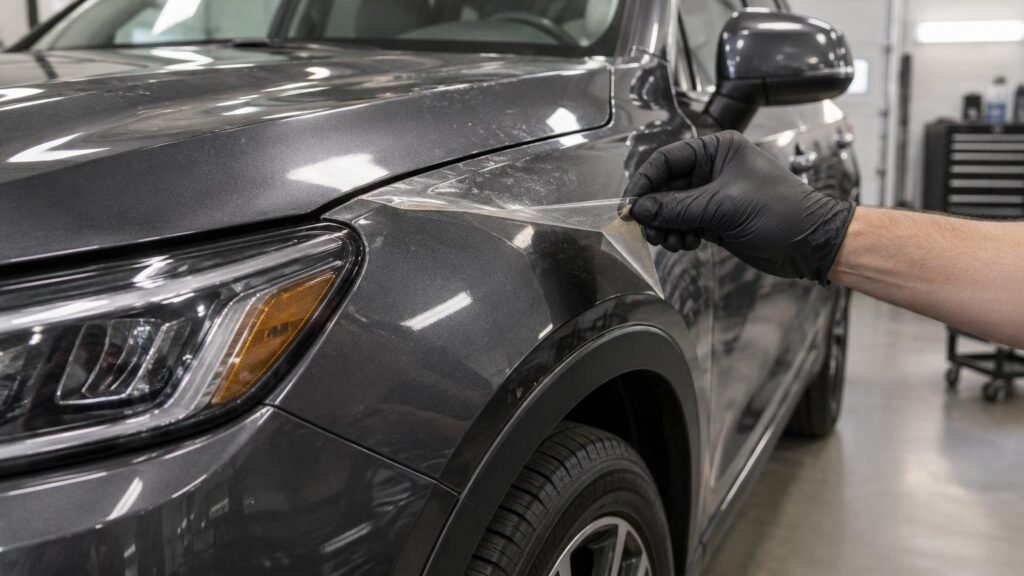
Old-film removal should be controlled rather than treated like peeling a temporary sticker. Variables such as film temperature, pull direction, pull angle, panel shape, and the way brittle sections are managed can affect the stress placed on the finish. Complex edges, plastic bumpers, repainted panels, and areas where the film repeatedly fractures deserve extra caution.
XPEL recommends professional PPF removal. Its consumer care guidance describes using steam and keeping the pull angle shallow—below 45 degrees—when professional removal is not possible. That guidance belongs to XPEL products and should not be converted into a universal procedure for unidentified film, unknown adhesive, or questionable paint.
This is also why aggressive heat or improvised chemicals are poor default responses. Too much heat can affect film behavior, paint, adjacent trim, or plastic parts, while an unsuitable solvent can create a separate surface problem. Manufacturer instructions for the identified film and finish should take priority.
Adhesive residue is not automatically paint damage
A panel may retain adhesive after the film separates. Residue can look alarming because it leaves a patchy, dirty, or textured surface, but residue alone does not establish that clear coat or color coat has failed. It is primarily a cleanup and assessment issue.
The exposed panel should be cleaned with products and methods compatible with the paint and the identified adhesive. Once residue is removed, the finish can be evaluated for staining, scratches, chips, clear-coat failure, paint lift, or differences in gloss and color between covered and uncovered areas. Avoid jumping directly to polishing, sanding, or another aggressive correction before identifying the actual condition.
Should new PPF be installed immediately?
Not necessarily. A sound panel may only need appropriate cleaning and preparation before new film, but a compromised panel may need paint correction, body-shop evaluation, or refinishing first. Installing new PPF over unstable paint does not repair the adhesion problem and may make a future removal equally uncertain.
The replacement decision should also consider why the original film aged poorly. Outdoor exposure, neglected edges, impact damage, panel location, and the film’s documented service condition may affect whether the same coverage still makes sense. Owners can replace the original coverage, reduce it to high-impact areas, or expand it if their current driving exposure justifies more protection.
Do PPF warranties cover underlying paint damage?
Do not assume that a film warranty is paint-damage insurance. Warranty scope varies by manufacturer and product. XPEL, for example, states that its PPF warranty applies to the film rather than damage to the underlying paint. Its published terms also address circumstances involving paint or body repairs and areas that are not re-wrapped afterward.
Before authorizing removal, locate the warranty for the exact film if it is known. Review who must perform the work, what records are required, which defects are covered, and what exclusions apply. A general statement that PPF is removable does not override product-specific terms or guarantee the condition of a repaired finish.
When to avoid DIY removal
Arrange an inspection before pulling on the film when any of these conditions apply:
- The film is brittle, cracked, heavily discolored, or breaking into small pieces.
- Clear coat is peeling, chalky, oxidized, or visibly failing near a film edge.
- The panel was repainted, blended, repaired, or replaced.
- The vehicle’s collision and paint history is unknown.
- Film edges cross touch-up paint, exposed chips, rust, or existing damage.
- The panel is plastic, sharply contoured, or otherwise likely to require careful heat management.
- You need to preserve evidence for a film, installation, paint, or repair warranty claim.
The practical decision
Old PPF does not inevitably damage paint during removal. Sound factory paint and properly cured, well-bonded refinishing can often release film successfully when the work is performed correctly. The difficult cases are those where degraded film meets weak, repaired, oxidized, or undocumented paint.
Start by identifying the film if possible, gathering repair records, and examining each panel for visible warning signs. If the film is failing or the paint history is uncertain, seek a professional assessment before lifting an edge. The goal is not to promise a risk-free outcome; it is to recognize the variables early, use a controlled removal plan, and decide what the exposed paint needs before installing protection again.