
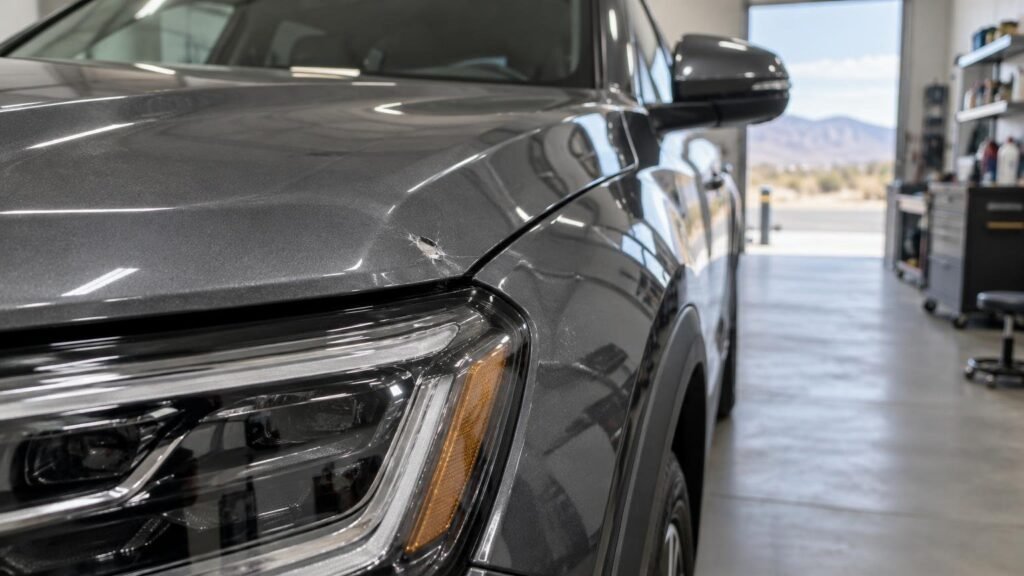
A rock can strike with enough force to cut through paint protection film and chip the paint beneath it. When that happens, the film has not necessarily “failed.” PPF reduces risk from road debris and abrasion, but no film can make paint invulnerable to every impact. The repair becomes a two-part job: address the damaged paint, then decide how to restore the protective film.
Do not assume every white spot or crater is paint damage. A mark can be confined to the film, a puncture can leave the paint intact, or the impact can pass through both film and paint. Those conditions call for different responses. Start with a careful diagnosis rather than immediately applying touch-up paint or pulling at the film.
First determine how far the impact traveled
Wash the area gently by hand so dirt does not disguise the damage. Avoid directing a pressure washer at the mark or a lifted edge. Both 3M’s official film support guidance and XPEL’s product-care instructions warn that high-pressure water around film or its edges can undermine adhesion. If the strike has already opened a path beneath the film, forceful water can make the affected area larger.
Inspect the clean, dry area under bright, angled light. Look from several directions, but do not pick at a flap or push a sharp tool into the mark. The visible condition usually falls into one of three broad categories:
| What you see | Likely condition | Practical next step |
|---|---|---|
| A light scuff or shallow line with no opening in the film | Surface-level film mark | Identify the film and ask whether its approved care process can address the mark. |
| A cut, crater, lifted flap or puncture, but no obvious paint loss | Compromised film with possibly intact paint | Have an installer inspect the area and determine whether the film needs replacement. |
| A puncture with a visible contrasting spot or exposed substrate beneath | Possible paint damage through the film | Arrange film removal and paint assessment before choosing a cosmetic repair. |
A photo can help an installer triage the problem, but film can obscure the chip’s depth and edges. A definitive assessment may require controlled removal of the damaged film. Manufacturer guidance favors professional involvement in film removal; XPEL describes steam-assisted removal at a shallow angle, while 3M directs owners to an authorized installer. This is especially important when the panel has previous bodywork, uncertain paint history or a lifting film edge. For more context, see what owners should know before removing PPF from painted panels.
Self-healing film cannot repair a puncture or missing paint
“Self-healing” is easy to misread after a rock strike. XPEL describes that feature as recovery from light scratches on certain films. It does not mean a torn film will close a puncture, nor can the film regenerate clear coat, color coat or primer lost beneath it. Heat may improve an eligible shallow surface mark, but it is not a repair for impact damage.
That distinction helps prevent an unproductive wait-and-see approach. If the film has an open cut, raised flap or crater reaching the paint, treat it as physical damage. The limits of self-healing PPF explain why shallow topcoat marks and deep cuts belong in different repair categories.
The correct repair sequence starts with film removal
A sensible sequence is:
- Document the damage with close and wider photos before washing or removal.
- Clean the area gently and avoid high-pressure water, aggressive rubbing, solvents and picking at the film.
- Ask a PPF installer to evaluate the film and its edges. If paint damage is apparent or likely, coordinate removal with the person performing the paint repair.
- Inspect the uncovered paint to determine whether the chip is suitable for touch-up or needs a more extensive refinishing process.
- Complete the paint repair and follow the paint supplier’s or body shop’s curing instructions.
- Reinstall film only after the repaired surface is ready for adhesion, then inspect the new edges and finish.
For a tiny chip, a careful touch-up may be an acceptable cosmetic compromise, particularly on a daily-driven vehicle where the goal is to seal and reduce the visibility of the spot rather than recreate a factory-level surface. A larger chip, cracking, deformation, multiple impact points or a highly visible panel may justify professional refinishing. The appropriate choice depends on the depth and area of damage, the paint system, the vehicle’s value and the owner’s appearance standard.
Touch-up paint also does not automatically create an invisible foundation beneath clear film. PPF follows the surface below it, so a raised repair, recessed crater, mismatched color or rough edge may remain visible. The related guide to installing PPF over rock chips or touch-up paint covers why film preserves rather than corrects the surface underneath.
Let repaired paint cure before applying new PPF
Freshly repaired paint should not be covered according to a generic internet countdown. Paint systems, products, application methods and shop conditions vary. Follow the refinisher’s written recommendation and tell the paint shop that an adhesive film will be installed afterward.
In its March 2024 paint protection film FAQ, 3M says to follow the paint supplier’s recommendation after refinishing and notes that most installers wait at least 30 days to help reduce risk. That is useful planning guidance, not a universal cure specification for every repair. If the body shop or paint manufacturer specifies a different interval for the exact system used, that product-specific direction should control the schedule.
Do not rush this stage merely because the vehicle is temporarily without film on one panel. Premature installation can create avoidable questions about adhesion, trapped solvents and future removal. During the waiting period, use the paint shop’s care instructions and avoid improvised temporary adhesives over the repair.
Does the entire panel of PPF need replacement?
Usually, the cleanest restoration is to replace the film section covering the affected panel. A small patch can protect a localized spot, but it introduces visible edges and may collect dirt along its perimeter. On a hood, bumper or fender with one-piece coverage, replacing the panel’s film generally produces a more consistent appearance than stacking a small patch over the damage.
That does not mean the entire vehicle must be rewrapped. If one hood section was punctured, undamaged film on the bumper, mirrors, fenders or other panels can often remain. The installer should compare the replacement film’s finish with the existing material and consider film age, gloss, discoloration, edge condition and pattern placement. Matte, satin and color PPF can make matching especially important because a small finish difference may be more visible across adjacent panels.
On partial-hood coverage, another seam also deserves thought. Replacing only the existing partial section preserves the original coverage plan, but the repaired spot and replacement line may remain visually noticeable. Moving to full-hood coverage can eliminate the cross-hood seam and protect more of the panel, though it adds cost. The impact itself does not make that upgrade mandatory.
Rock strikes are commonly excluded from film warranties
A film warranty and impact protection are different things. Current 3M support information excludes physical impacts from rocks or road debris from its limited warranty. XPEL’s current warranty also excludes damage caused by outside forces, including rock and road-debris impacts, and lists chips to the painted surface among its exclusions.
Those exclusions do not determine whether an installer policy, supplemental protection plan or auto-insurance policy applies. Coverage depends on the actual terms of that separate agreement. Save photos, the installation invoice, film details and paint-repair estimate before authorizing work if you plan to ask about coverage. Avoid assuming that either “PPF warranty” or “comprehensive insurance” automatically pays for the event.
Use the damage to reassess coverage, not to overreact
One puncture does not prove that full-body PPF is necessary, and it does not prove that the existing film was pointless. Consider what the panel would likely have faced without the sacrificial layer, while recognizing that the exact avoided damage cannot be measured after the fact. The useful question is whether the strike reveals a recurring exposure pattern.
If repeated impacts appear on the leading bumper, full hood, fenders or mirror caps, a broader full-front layout may reduce exposed transitions. Trucks and SUVs that regularly encounter gravel, winter debris or unpaved access roads may benefit from targeted rocker, lower-door or rear-wheel-impact coverage. A single isolated chip on a low-exposure panel may justify nothing more than restoring the original section.
Utah freeway mileage, construction zones, canyon travel and loose aggregate can increase exposure, but no route or coverage package guarantees a chip-free vehicle. 3M identifies hoods, bumpers, mirror backs, rocker panels, door edges and trunk ledges as common PPF application areas because these zones frequently benefit from physical protection. Prioritize the panels that match how the vehicle is actually used.
The practical answer after a chip breaks through PPF
When a rock chip reaches paint through PPF, diagnose the film and paint as separate layers. Keep pressure washers and picking tools away from the damaged spot, document it, and let a qualified installer remove compromised film. Repair the exposed paint to the cosmetic standard appropriate for the vehicle, observe the paint system’s curing guidance, and then restore film coverage if it still makes sense.
For many owners, the proportionate solution is paint repair plus replacement of one panel’s film—not a full vehicle rewrap. The best outcome comes from preserving the surrounding paint, accepting that PPF reduces rather than eliminates impact risk, and choosing replacement coverage based on future exposure rather than frustration over one hard strike.