Paint protection film can sometimes be installed over small rock chips or sound, fully cured touch-up paint. The important limitation is that PPF protects the surface as it exists; it does not replace missing paint, flatten a raised repair, stop active corrosion, or reattach failing clear coat.
If you are researching “PPF over rock chips touch up paint,” the best sequence is inspection first, paint or body repair when needed, adequate curing time, and then film installation. A shallow, stable chip may be acceptable beneath PPF. Soft touch-up paint, rust, peeling clear coat, or questionable bodywork should be resolved before the panel is covered.
What PPF over rock chips and touch-up paint actually looks like
Clear PPF is transparent and conforms closely to the panel. It should not be treated like body filler or a cosmetic correction product. A crater from missing paint can remain visible. A mismatched touch-up color can still look mismatched, and a raised blob can create a visible bump or distortion beneath the film.
The practical appearance depends on the chip’s size, depth, location, color contrast, and repair quality. A tiny chip on a light-colored lower bumper may be difficult to notice from normal viewing distance. A dark crater on a light hood, or a tall touch-up ridge in a reflection line, may remain obvious after installation.
The official 3M vehicle-installation FAQ says surface defects such as scratches, dents, bubbling, pitting, and orange peel may remain visible through film. It also identifies proper surface finishing as relevant before installation. That is the right expectation for rock chips: film may protect the area from additional exposure, but it does not erase the defect.
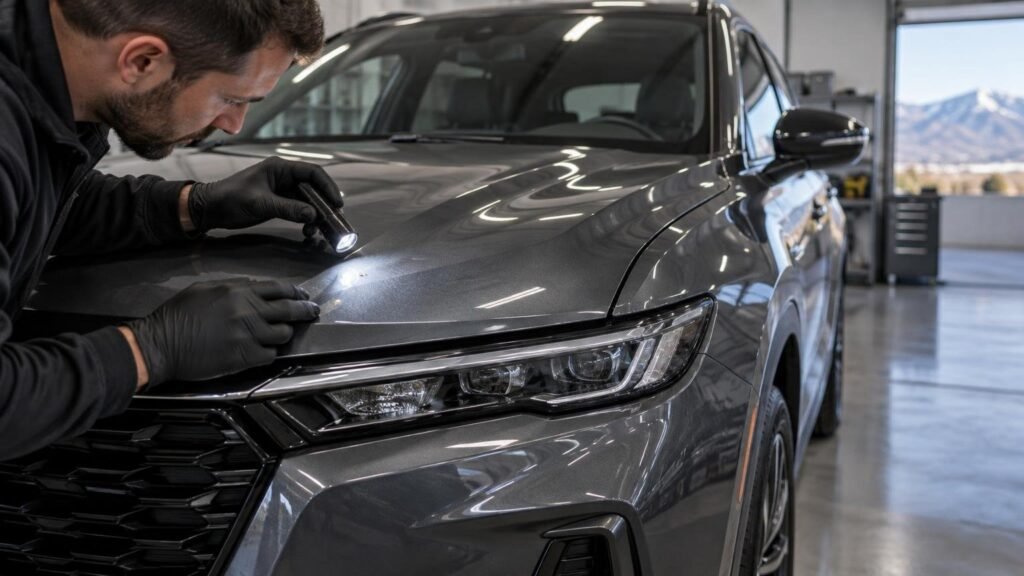
Inspect the chip before deciding what to cover
A useful inspection is about stability as much as appearance. The installer needs to understand what is beneath and around the chip, not simply whether the mark is small in a photograph.
- Is the damage limited to the clear coat, or is color coat, primer, metal, or plastic exposed?
- Is there rust, staining, bubbling, lifting paint, or a spreading edge around the chip?
- Has touch-up paint been applied, and is it hard, clean, smooth, and firmly bonded?
- Does the repair stand above the surrounding paint as a ridge or blob?
- Has the panel been repainted or repaired after collision damage?
- Is the clear coat peeling, cracking, or separating elsewhere on the panel?
- Is wax, sealant, ceramic coating, polishing residue, or contamination present in the installation area?
Photos can help identify obvious defects, but they may not reveal whether touch-up material is still soft or whether a repainted surface has weak adhesion. When the history is uncertain, an in-person inspection is more useful than assuming the panel is ready.
Condition-by-condition guidance
| Surface condition | Likely next step | What to expect under PPF |
|---|---|---|
| Small, stable rock chip | Inspect and decide whether cosmetic touch-up is worthwhile before film | The chip may remain visible because clear film does not replace missing paint |
| Smooth, firmly bonded touch-up repair | Confirm full cure and compatibility before installation | The repair may be less conspicuous, but its color and texture can still show |
| Raised, rough, or soft touch-up paint | Have the repair assessed and corrected before film | Film can conform over the high spot and make surface distortion noticeable |
| Exposed metal or suspected rust | Address corrosion and restore the paint system first | PPF is not a rust treatment and should not be used to seal in an unresolved problem |
| Peeling, bubbling, or lifting clear coat | Repair the unstable finish before installation | Film relies on the surface beneath it; covering failed paint does not stabilize it |
| Fresh repaint or body repair | Wait for full cure under the paint supplier’s and film manufacturer’s guidance | Installing too early can interfere with outgassing or create avoidable installation and removal concerns |
| Previously repainted but apparently sound panel | Inspect the repair history and finish quality before proceeding | Installation may be possible, but future removal is less predictable than on known, sound factory paint |
Should touch-up paint go on before or after PPF?
When a chip needs touch-up, completing that work before PPF usually produces the more logical sequence. It keeps the repair directly on the painted panel and allows the finished surface to be assessed before it is covered. The touch-up must be fully cured—not merely dry to a light touch—and suitable for film installation.
Touching up a chip after PPF installation is different. The film sits over the paint, so a chip already beneath properly installed film is not directly accessible. Cutting or lifting installed film solely to reach a defect can compromise the film and may damage the surrounding installation. If an existing chip needs meaningful correction, decide that before applying PPF.
Do not assume that every raised repair can simply be sanded flat. Correcting touch-up paint without damaging adjacent factory clear coat requires judgment and appropriate paint-finishing methods. A rough, oversized, or poorly matched repair may need evaluation by a qualified paint professional before the film appointment.
How long should touch-up paint or a repainted panel cure?
There is no responsible universal cure time for every touch-up pen, aerosol system, refinished panel, climate, or paint chemistry. Dry-to-touch time and full-cure time are not interchangeable. Follow the paint product manufacturer or body shop’s instructions, then confirm that timing against the requirements for the selected film.
3M’s FAQ states that recently applied paint should be fully cured according to the paint manufacturer’s instructions before film installation. LLumar describes 30 days as a common waiting period for freshly painted vehicles so the paint can outgas, but that is a general reference rather than a rule for every repair or film system. If the paint shop specifies a longer period, or the film documentation imposes a different requirement, use the guidance applicable to that exact job.
Temperature, repair depth, number of layers, and the paint system can all affect curing. Scheduling PPF around an assumed number of days without identifying the repair materials creates unnecessary risk.
Why peeling clear coat, bubbling paint, and rust should be repaired first
PPF needs a clean, stable substrate. Peeling clear coat and bubbling paint indicate that part of the finish is no longer securely attached. Applying adhesive film over that failure does not restore the bond between paint layers.
Rust also requires paint or body repair rather than concealment. Film can cover the view of a spot, but it does not remove corrosion or rebuild the protective paint system. Exposed metal should be assessed promptly. A chip into a plastic bumper cannot rust like steel, but missing or unstable paint still affects appearance and the quality of the surface beneath the film.
Professional PPF installation guidance emphasizes substrate condition and preparation because film performance depends partly on the surface receiving it. A panel that is unsuitable before installation does not become sound merely because it has been covered.
Repainted bumpers, hoods, and repaired panels need extra context
A repainted panel is not automatically disqualified from PPF. The useful questions are whether the repair has fully cured, whether the finish is stable, and whether the shop that performed the work has provided relevant aftercare or film-installation guidance.
Repair history matters again when the film is eventually removed. Removal outcomes depend on paint condition, prior bodywork, film age and condition, environmental exposure, and removal technique. Sound factory paint and an unknown or unstable repaint should not be treated as equivalent surfaces. For a closer look at this distinction, see how paint condition affects PPF removal.
No responsible inspection can guarantee that weak touch-up paint or poorly bonded refinishing will remain attached during later removal. Conversely, the existence of a repaint does not prove that failure will occur. It means the condition and repair history deserve assessment before installation and before removal.
What if the panel already has ceramic coating?
An existing ceramic coating adds a surface-preparation question; it does not solve the chip. The damaged area still needs to be inspected, repaired if appropriate, and allowed to cure. The installer must then prepare the panel according to the requirements for the selected film rather than assuming the coating is a suitable bonding surface.
If touch-up or refinishing is planned, tell the paint professional and PPF installer about the coating. The appropriate preparation can vary with the coating, repair area, and film system. The broader sequence is explained in this guide to installing PPF over ceramic coating.
Is PPF still worthwhile after a vehicle has rock chips?
Often, yes—provided expectations are realistic and the surface is suitable. Existing chips do not mean the rest of the panel has no value to protect. A high-mileage Utah vehicle may continue to face freeway debris, construction grit, canyon travel, and winter road grime. Protecting an appropriately prepared bumper, hood, fenders, mirrors, or lower panels can reduce future exposure on the covered areas.
The choice does not have to be full-body film. If most existing damage is concentrated on the front, a full-front or targeted high-impact package may provide a sensible balance between protected area, appearance, and cost. If the hood has extensive cosmetic damage while the bumper and fenders remain presentable, it may also make sense to repair one panel and protect several others rather than treating every surface identically.
Make the surface decision before the coverage decision
PPF can go over some rock chips and properly cured touch-up repairs, but suitability depends on the condition of the paint. Small and stable defects may simply remain visible beneath the film. Raised repairs, soft paint, corrosion, peeling clear coat, and unresolved bodywork call for correction before installation.
Start with a close inspection, complete any necessary paint work, document the products or repair process when possible, and wait for confirmed full cure. Once the surface is stable, choose coverage based on future exposure and budget—not on an expectation that PPF will repair damage already present.
Frequently Asked Questions
Can PPF be installed over touch-up paint?
Yes, if the touch-up paint is sound, firmly bonded, compatible with the film, and fully cured. Soft, rough, raised, or unstable repairs should be assessed and corrected first.
Will clear PPF hide a rock chip or raised touch-up paint?
Not necessarily. Clear film closely follows the underlying surface, so missing-paint craters, color differences, raised repairs, and other defects may remain visible.
Should touch-up paint be applied before or after PPF?
When touch-up is needed, it should generally be completed and allowed to cure before PPF installation. Once film is installed, cutting or lifting it to reach a covered chip can compromise the installation.
How long should touch-up paint or a repainted panel cure before PPF?
There is no universal cure time. Follow the paint manufacturer or body shop’s full-cure instructions and confirm them against the selected film’s requirements. LLumar describes 30 days as a common waiting period for fresh paint, but it is not a rule for every repair or film system.
Can PPF cover rust, peeling clear coat, or bubbling paint?
Those conditions should be repaired first. PPF does not remove corrosion or restore adhesion between failing paint layers, and installation performance depends on a properly prepared, stable surface.