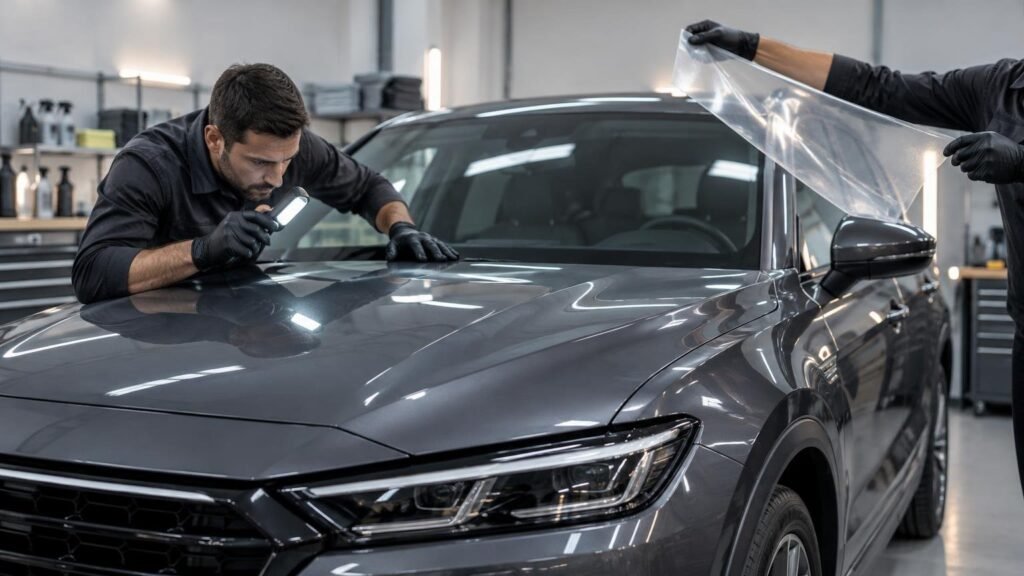
Installing PPF over ceramic coating is not something to approve based only on whether the paint looks clean. An existing coating may need to be professionally removed so the paint can be prepared according to the requirements of the exact film being installed. For example, 3M directs installers to remove ceramic coating professionally before applying its paint protection film. 3M’s official auto film support guidance
The safer order is usually inspection, necessary coating removal, paint preparation, PPF installation, and then—if desired—a compatible ceramic coating over the film. That final coating must be suitable for the named PPF product and finish. Manufacturer approval for one combination does not establish compatibility for every gloss, matte, satin, or color film.
Can you install PPF over ceramic coating?
Do not assume an installer can apply PPF directly over an existing ceramic coating. The film manufacturer’s current installation instructions should control the decision. If those instructions require coating removal, or if the existing product cannot be identified, the coating should not be treated as an approved installation surface.
This is also why “the coating is old” is not enough information. Age alone does not establish that a coating is completely gone or that the surface is ready for film. Washing and decontaminating the vehicle may remove dirt and bonded contamination, but those steps should not be confused with verified coating removal.
The installer needs to evaluate the actual surface rather than rely on a previous detailer’s date or a visual guess. Removal and preparation methods should be selected for the coating, paint condition, panel history, and PPF system. Owners should avoid experimenting with aggressive abrasives or chemicals before the assessment because unnecessary correction can reduce the options available to the installer.
The recommended installation order
A compatibility-focused installation generally follows this sequence:
- Inspect the paint, existing coating, repaint history, touch-up work, and any previous film or vinyl wrap.
- Identify the ceramic coating when records are available and compare the surface requirements with the selected PPF manufacturer’s current instructions.
- Remove the coating where required and prepare the painted surface for film installation.
- Evaluate chips, scratches, oxidation, clear-coat concerns, and other defects before deciding whether any paint correction is appropriate.
- Install the selected PPF coverage.
- Follow the film-specific settling, washing, and aftercare instructions supplied at handoff.
- Apply a compatible coating over the film only when the PPF and coating manufacturers permit that combination and the required timing has been met.
This order keeps the physical protective layer closest to the properly prepared paint. A ceramic coating can then be considered as a surface-behavior and maintenance option over the PPF rather than as an unverified base underneath it. For a deeper explanation of that sequence, see why installation preparation usually comes before ceramic coating.
Why surface preparation matters
PPF installation depends on more than a glossy appearance. The surface may contain coating residue, wax, sealant, polishing oils, road film, old adhesive, touch-up paint, or defects that affect how the installer approaches the panel. Proper preparation creates a known starting point that matches the film maker’s installation guidance.
Preparation is not the same as automatically pursuing maximum paint correction. Correction changes appearance by addressing eligible paint defects; PPF preparation is about making the surface suitable for film. A daily-driven vehicle with minor defects may not need an extensive correction process if the owner accepts how those defects will look beneath the film. Conversely, a visible scratch under a clear gloss film may become more noticeable once the surrounding surface looks uniform.
The right choice depends on paint thickness, defect depth, ownership goals, budget, and whether the panel has been repainted. PPF reduces exposure to future abrasion and road debris, but it does not repair existing paint or make unstable clear coat sound.
What to disclose during the pre-installation inspection
Give the installer as much surface history as possible, even if some details are uncertain. Useful information includes:
- The ceramic coating’s manufacturer, product name, application date, and installer, if known.
- Any paint correction, wet sanding, body repair, repainting, or clear-coat work.
- Stone chips, touch-up paint, scratches, peeling, oxidation, or areas where clear coat appears compromised.
- Previous PPF or vinyl wrap, including when it was installed and removed.
- Panels with matte, satin, color-shifting, textured, or other nonstandard finishes.
- Recent use of waxes, spray sealants, ceramic boosters, or detailing products.
- Whether the vehicle has factory paint, factory matte paint, aftermarket paint, or an unknown repair history.
Repainted panels are not automatically excluded from PPF, but their condition and repair history deserve closer attention. Adhesion and later removal can be less predictable when paint quality or preparation is uncertain. Owners concerned about that issue can review what affects paint during eventual PPF removal before approving coverage.
PPF and ceramic coating do different jobs
PPF and ceramic coating can complement each other, but they are not interchangeable. Keeping their roles separate prevents unrealistic expectations.
| Layer | Primary role | What it should not be assumed to do |
|---|---|---|
| Paint protection film | Adds a physical film layer over selected painted panels to reduce damage from ordinary road debris and abrasion. | Prevent every chip, puncture, scrape, or impact. |
| Compatible ceramic coating over PPF | May improve water behavior, stain resistance, and ease of cleaning when supported by the relevant product guidance. | Add meaningful rock-chip protection or make the film invulnerable. |
| Paint correction and preparation | Addresses eligible appearance defects and creates an installation surface appropriate for the selected film. | Repair failing clear coat, guarantee adhesion, or erase deep paint damage. |
3M’s installation guidance describes its Ceramic Coating and Ceramic Boost as options intended to add hydrophobicity, stain resistance, and easier cleaning to applicable PPF. It also says other coatings should be tested in an inconspicuous area. Those statements apply to the documented 3M system; they are not blanket approval for every third-party combination.
Likewise, XPEL states that ceramic coating can be applied over its PPF and specifically says its named FUSION PLUS coating does not void its PPF warranty. XPEL also distinguishes between ULTIMATE PLUS and ULTIMATE FUSION by describing the latter as having a hydrophobic topcoat. This is another example of product-system-specific guidance rather than a universal rule.
Compatibility depends on the film, coating, and finish
Before adding ceramic coating over PPF, identify both products—not merely their brands. A manufacturer may sell multiple film series with different topcoats, finishes, installation guidance, and care requirements. The same is true of coatings.
Finish is especially important. A product or application method appropriate for glossy PPF may not be appropriate for matte or satin film. Uneven application can also be more visually consequential on a low-gloss surface. Color PPF introduces the same need for exact product identification because it combines an appearance change with a protective film layer.
There is no universal waiting period
Wash and coating intervals vary by product documentation. Even guidance from one manufacturer can differ by document or film series. In the supplied 3M materials, the general support page says to wait one week before washing, while an installation guideline says to wait at least 72 hours. The technical guideline also distinguishes coating timing by film series, including different windows for Series 100/50 and Series 150/200.
The practical rule is to follow the current instructions for the exact installed film and the installer’s written handoff guidance. Do not replace those directions with a generic internet rule such as “three days for every film” or “coat it immediately.” Weather, installation details, edge treatment, film series, and the planned coating system can all change the appropriate process.
After the initial period, maintenance should still be film-specific. If marks or defects later appear in the film, diagnose them before polishing or applying more products. The guidance in whether and how PPF can be polished explains why the film identity and defect type matter.
Choose the PPF coverage before planning the coating
Coverage should be based on exposure, not on the assumption that a ceramic coating will make unprotected paint equivalent to filmed paint. Utah drivers with frequent I-15 mileage may prioritize a full front. Trucks and SUVs exposed to gravel, winter grime, or unpaved access roads may add rocker panels and lower doors. Door cups, edges, and loading areas can be selected for repeated contact rather than road impacts.
Full-body PPF is not automatically necessary. Partial-front, full-front, targeted high-impact, and full-vehicle coverage are all legitimate options, and Wasatch PPF presents those choices as decisions tied to vehicle use, paint condition, priorities, and budget. Once coverage is selected, any compatible coating can be planned around the actual filmed and unfilmed surfaces.
Start with a surface-history assessment
If your vehicle has already been coated, the useful next step is an in-person assessment rather than a promise that film can go directly on top. Bring coating records and disclose repainting, touch-up work, correction, previous film, and recent detailing products. Ask which PPF product is being considered, what preparation its manufacturer requires, and whether any proposed coating is approved for that exact film and finish.
The central decision is straightforward: prepare the paint for the PPF system first. Add ceramic coating afterward only when compatibility, timing, finish, care, and warranty requirements are clear. That sequence preserves the distinct purpose of each layer and avoids treating an unknown coating as an acceptable installation surface.
Frequently Asked Questions
Can PPF be installed directly over an existing ceramic coating?
Do not assume an existing coating is a suitable base. Follow the selected film manufacturer’s instructions; 3M, for example, directs installers to have ceramic coating professionally removed before applying its PPF.
Should PPF or ceramic coating come first?
The usual sequence is to inspect and prepare the paint, install the PPF, and then add a compatible ceramic coating if the film and coating manufacturers permit it.
Can any ceramic coating be applied over any PPF?
No. Compatibility depends on the exact film, coating, and finish. Guidance for one product system does not establish compatibility for every gloss, matte, satin, or color film.
Does ceramic coating add rock-chip protection to PPF?
It should not be treated as impact protection. A compatible coating may improve water behavior, stain resistance, and ease of cleaning, while PPF provides the physical protective layer.
How long should you wait before washing newly installed PPF?
Follow the current instructions for the exact film and the installer’s written handoff guidance. The supplied 3M documents give different intervals—one week on a support page and at least 72 hours in an installation guideline—so there is no single interval that applies to every film.