TLDR: Can you polish PPF? Sometimes, but only when the care instructions for the exact film permit it. Manufacturer guidance ranges from allowing limited non-abrasive hand polishing to saying polishing is unnecessary and warning against abrasive products. Before doing anything, identify the film, finish, installation date, surface treatment, and type of defect. Do not treat machine polishing as a universal PPF maintenance method.
The important question is not simply whether a polisher can make a mark less visible. It is whether the proposed correction is appropriate for the film’s topcoat, finish, age, and warranty terms. A faint mark in glossy film, a mineral deposit, damage to a ceramic coating, and a cut through the film can look similar at first glance but require very different responses.
Can you polish PPF safely?
There is no universal yes-or-no answer. The official 3M Paint Protection Film Installation Guideline warns against abrasive polishes and rubbing compounds. STEK says its self-healing top-coated PPF does not need polishing and warns against abrasives. Profilm, by contrast, permits hand polishing after its stated curing period and says a non-abrasive polish can be used to maintain gloss. These instructions cannot be combined into one rule for every film.
That variation is why advice such as “use a finishing pad and light polish” is incomplete when the installed product is unknown. Even a mild automotive polish removes or alters some material through chemical action, mechanical abrasion, or both. A method intended for hard automotive clear coat may not be suitable for a softer film surface or its functional topcoat.
If the manufacturer explicitly permits a non-abrasive hand polish, follow that product-specific method and its curing requirements. If the documentation says polishing is unnecessary or prohibits abrasive products, do not substitute a machine, compound, or aggressive pad based on generic detailing advice.
Identify the film before trying to correct it
Start with the installation invoice, warranty registration, or installer records. A useful identification includes more than the brand name. You need the named product line because one manufacturer may offer gloss, matte, satin, color, textured, and specialty films with different surface constructions.
- Manufacturer and exact product line
- Gloss, matte, satin, color, textured, or another finish
- Installation date and required curing period
- Whether a ceramic coating, sealant, wax, or other treatment is on top
- Location and appearance of the defect
- Current manufacturer care and warranty documents
If those details are unavailable, the low-risk choice is to pause corrective work. Ask the installer to identify the product from its records or inspect the film. Guessing is especially risky when a machine polisher, compound, stain remover, solvent, or heat source is being considered.
Why the curing period matters
Newly installed PPF needs time to settle, but the published care window is not identical across manufacturers. The supplied 3M guidance references waiting 72 hours before washing, while Profilm states a two-week period before washing or polishing. Follow the longer or shorter period only when it belongs to the product actually installed on the vehicle.
Polishing too early adds unnecessary contact, pressure, liquid, and potential heat while the installation is still settling. If the film was installed recently, small moisture patterns or visual irregularities may also need installer evaluation rather than immediate correction. Do not assume every visible issue is a scratch.
Diagnose the mark before choosing a method
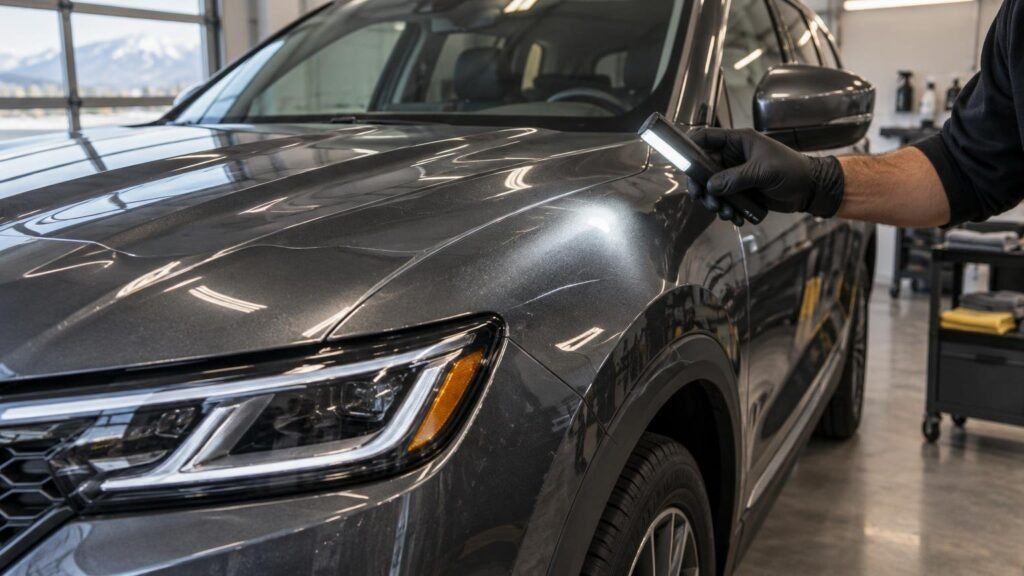
A useful diagnosis separates material sitting on the surface from damage within or through the film. Wash and inspect the area under diffuse light before deciding that polishing is necessary. Use only cleaning products and techniques allowed by the film manufacturer.
Light surface marring
Some named PPF products are designed so certain shallow surface marks can become less visible with appropriate heat. STEK and LLumar describe heat-assisted healing for minor surface scratches on specified films, but that does not mean every film self-heals or that every mark can be repaired. The distinction between shallow marring and permanent damage is explained further in this guide to how self-healing PPF works.
Check the product instructions before adding heat. Sun exposure, warm water, or another manufacturer-approved approach may be specified, but an uncontrolled heat gun can concentrate heat in a small area. Polishing should not be the automatic first step when the film’s own topcoat may address superficial marring through an approved process.
Mineral spots, grime, or bonded contamination
A mark that looks like a scratch may instead be a deposit on the film or on a coating above it. Begin with a gentle wash after the required curing period. If the mark remains, consult the film’s approved care products rather than escalating immediately to compound. Manufacturer guidance commonly emphasizes non-abrasive, product-appropriate care and avoidance of harsh or abrasive products.
Contamination should be removed promptly, but “stronger” is not automatically safer. Abrasive pads, pigmented or abrasive waxes, rubbing compounds, and harsh chemicals are identified as risks or prohibited products in the cited manufacturer guidance.
Ceramic-coating or sealant problems
If a ceramic coating or other treatment sits over the PPF, the visible problem may be in that upper layer rather than the film. Polishing could partially remove the coating, create uneven water behavior, or expose only part of the underlying film. Identify both products and consult both sets of instructions. The order and compatibility of these layers matter, as discussed in the guide to ceramic coating and PPF installation prep.
Deep cuts, punctures, lifting, or topcoat failure
Polish cannot rebuild missing film, close a puncture, reattach a lifting edge, or restore a failed topcoat. Deep damage may require localized film replacement or replacement of the covered panel section. Continuing to abrade a compromised area can make inspection and repair more difficult.
Seek professional assessment when a mark catches a fingernail, has a visible opening, changes appearance when wet, follows an edge that is lifting, or looks cloudy beneath the surface. These signs do not prove a particular failure, but they are good reasons to stop experimenting.
Treat matte, satin, color, and textured PPF differently
Do not apply gloss-film correction advice to a specialty finish. Matte and satin films depend on a controlled surface appearance. A process intended to increase gloss can create a locally shiny patch that is more noticeable than the original mark. Color and textured films may also have product-specific topcoats and appearance requirements.
Unless the documentation for the exact specialty film explicitly permits a particular correction, avoid polishing it. Even if a product is described broadly as PPF, that category label does not establish that it should be maintained like clear gloss film.
A low-risk decision process
- Find the manufacturer, exact product line, finish, and installation date.
- Confirm whether another coating or treatment is present above the PPF.
- Read the current care guide and warranty terms for that product.
- Wait through the specified post-installation curing period.
- Wash gently using approved products, then inspect the clean surface.
- Classify the issue as superficial marring, contamination, spotting, coating damage, lifting, a cut, or possible topcoat failure.
- Use self-healing or non-abrasive hand-care instructions only when the manufacturer explicitly provides them.
- Consult the installer or a PPF-experienced detailer before machine polishing, using abrasives, or correcting an uncertain defect.
Warranty language deserves attention before corrective work. A long warranty term by itself does not explain exclusions, approved maintenance, required records, or who pays for labor. Review the exact documents and ask whether the proposed correction could affect coverage. This PPF warranty comparison guide explains the details worth checking beyond the headline number of years.
When professional help is the better choice
Professional inspection is worthwhile when the film cannot be identified, the care guide is unclear, the finish is matte or otherwise specialized, a coating is present, or the defect appears deeper than surface marring. It is also the prudent next step before any machine-polishing attempt.
Bring the invoice, warranty information, product names, installation date, and a description of products already used. That information helps an installer or detailer distinguish a correctable surface issue from damage requiring film replacement. Ask for the proposed method in specific terms rather than accepting “we will buff it” as a complete plan.
Common questions about polishing PPF
How long should you wait before polishing newly installed PPF?
Use the curing period published for the exact film. Manufacturer windows differ: supplied 3M guidance references 72 hours before washing, while Profilm states two weeks before washing or polishing. A waiting period from one product should not be assumed to apply to another.
Does self-healing replace polishing?
For certain light surface marks on a self-healing product, the film’s approved heat-assisted process may make polishing unnecessary. It will not repair deep cuts, punctures, missing film, damage below the film, or every type of stain. Confirm that the named product has this feature and follow its instructions.
Can ceramic-coated PPF be polished?
Do not assume so. Correction may affect the coating before it reaches the film, and the coating may have its own maintenance rules. Identify both products and determine which layer contains the defect before choosing a method.
Can you pressure-wash PPF before inspecting a mark?
Pressure washing is not a correction method. Follow the film manufacturer’s washing instructions and allow the required curing time. If an edge is already lifting or the film appears punctured, avoid directing force at the damaged area and arrange an inspection.
Will polishing void a PPF warranty?
Not automatically in every case, but it can create a warranty issue if the product prohibits abrasives or the method damages the film. Check the exact warranty and care guide, then get confirmation before proceeding when the language is unclear.
The practical answer
Some glossy PPF may allow limited non-abrasive hand polishing, but that permission is product-specific. Other films are intended to be maintained without polishing and may be damaged by compounds, abrasive pads, excessive heat, or aggressive correction. Specialty finishes require even more caution.
Identify the film, let it cure, clean it gently, and diagnose the defect before trying to improve it. If the documentation does not clearly authorize the proposed method—or if a machine polisher is involved—stop and ask the installer or a PPF-experienced professional. Replacing a damaged section is sometimes the correct repair, and it is usually preferable to turning a small mark into permanent topcoat or finish damage.