TLDR: Do not plan on putting ceramic coating under PPF. Paint protection film needs a properly prepared surface, and at least one major film manufacturer explicitly instructs installers to confirm that ceramic coating is not present before installation. If the paint is already coated, tell the installer before the appointment. The usual sequence is paint assessment and preparation, PPF installation, initial film care, and then—if desired—a coating confirmed compatible with the exact film and finish.
The question about ceramic coating under PPF often starts with a reasonable assumption: if two forms of protection are useful, putting both directly on the paint should provide an even better foundation. The problem is that PPF is an adhesive film. Its bond to the prepared vehicle surface is central to the installation, so a prior coating cannot simply be treated as a harmless extra layer.
Ceramic coating is usually better considered after PPF installation, as a maintenance-oriented layer on top of a compatible film. That order preserves the film-to-paint installation sequence while allowing the coating to change water behavior, staining resistance, or cleaning characteristics where the product manufacturer supports those uses.
Can ceramic coating go under PPF?
The practical answer is no: do not have the vehicle coated first when PPF is the next planned service. In its official support information, 3M says paint protection film should not be installed over ceramic-coated paint and advises professional removal of an existing coating before film installation. Its paint protection film installation guideline also directs installers to confirm that no ceramic coating is present before applying PPF.
That does not mean every combination of film, coating, paint, and installation process is identical. It means the installer must follow the requirements for the named PPF system rather than assume an existing coating is compatible. If your vehicle has already been coated, provide the coating name, installation date, treated panels, and any available paperwork. Let the film installer determine the appropriate next step instead of trying to strip or abrade the surface at home.
Why the sequence matters for PPF adhesion
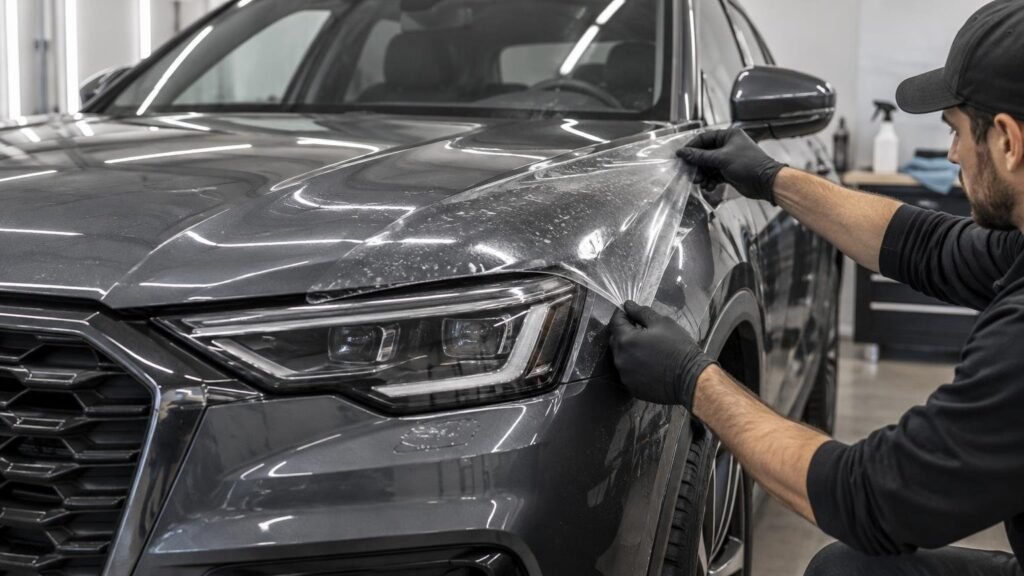
PPF is applied as a physical film with an adhesive side intended to make controlled contact with the vehicle surface. Installation preparation gives the installer a consistent substrate and helps reveal anything that could interfere with that contact. A ceramic coating changes the surface characteristics of the paint, which is precisely why its presence matters before an adhesive film is installed.
Preparation is not just about making the vehicle look clean. The installer also needs to assess contamination, paint defects, previous protection products, repairs, and damage that may affect the installation or remain visible under transparent film. Wasatch PPF likewise identifies paint condition, damage, and contamination as relevant considerations before film installation.
This is one reason a routine wash should not be confused with installation preparation. A surface may look clean while still carrying an existing coating or other material. The correct response is not to prescribe a universal chemical treatment; it is to identify what is on the vehicle and use the process approved for the film, paint, and coating involved.
The typical order for PPF and ceramic coating
For a vehicle receiving both services, use this sequence as the planning framework:
- Assess the paint. Identify chips, scratches, repainting, contamination, existing film, waxes, sealants, and any prior ceramic coating.
- Choose PPF coverage. Decide which panels need impact and abrasion protection based on driving exposure, ownership plans, appearance preferences, and budget.
- Prepare the surface for the selected film. The installer should follow the film manufacturer’s installation requirements and address any existing coating appropriately.
- Install the PPF. The film becomes the physical barrier on the selected painted panels.
- Follow the written initial-care instructions. Avoid relying on a generic waiting period because requirements differ among products.
- If wanted, apply a compatible coating over the film. Confirm that the coating is approved for the exact PPF product and its gloss, matte, satin, or color finish.
Coverage should be settled before coating because only the filmed panels receive PPF-style impact protection. For many Utah drivers, full-front or targeted coverage is a more useful starting point than full-body film. Freeway mileage, canyon travel, rocker-panel exposure, and cargo use can help determine which areas deserve priority. Ceramic coating does not expand the physical coverage of a partial PPF package.
What ceramic coating can add over PPF
A compatible coating can change how the film surface handles water and routine contamination. For example, 3M says its ceramic coating may be applied over its PPF to add hydrophobic behavior, stain resistance, and easier cleaning. Those are manufacturer claims for the applicable products, not universal promises for every film and coating combination.
Keep the roles clear. PPF is primarily a physical barrier against everyday road debris and abrasion. Ceramic coating primarily changes surface behavior and maintenance characteristics. A coating does not add PPF coverage to exposed paint, and it should not be presented as an equivalent substitute for film where impact protection is the goal.
Ceramic coating also should not be credited with giving every film self-healing behavior. Some named PPF products have self-healing properties of their own. For example, 3M describes heat-assisted self-healing for Scotchgard Paint Protection Film Pro Series 200. That is a feature attributed to that film, not an effect that every ceramic coating creates.
Compatibility is specific to the film and finish
“Safe for PPF” is not always specific enough. The installer should verify compatibility among the coating, film product, surface finish, and manufacturer requirements. XPEL, for example, identifies FUSION PLUS Paint & PPF as a coating developed for painted surfaces and PPF. It separately publishes FUSION PLUS SATIN guidance for satin paint and STEALTH PPF.
That distinction matters because a coating selected for glossy clear film may not be the appropriate choice for matte or satin film. The wrong product could alter the intended appearance or create maintenance and warranty questions. Color PPF also needs product-specific confirmation; it combines an appearance change with PPF-style protection and should not be treated as ordinary vinyl wrap or assumed to accept every coating.
Ask for the full product names rather than accepting broad labels such as “premium film” and “ceramic.” Written product identification makes it possible to check technical sheets, care instructions, and warranty terms for the actual combination.
Do not use a universal wait time after PPF installation
Aftercare timing varies. 3M says to wait one week after PPF installation before washing or waxing, while XPEL’s care guidance for ULTIMATE FUSION says to avoid washing for at least 48 hours. These instructions belong to different named systems and should not be blended into one rule.
Coating cure instructions can be separate again. XPEL’s technical data sheet for FUSION PLUS Paint & PPF lists a three-day cure and directs users to keep the coated surface dry for six hours. That timing applies to the named coating, not to ceramic coatings as a category.
Before leaving the installer, get written answers for when the vehicle may be washed, exposed to water, or treated with another product. If PPF and coating are performed by different businesses, make sure each knows the complete sequence and products involved.
PPF, ceramic coating, and vinyl wrap have different jobs
| Product | Primary purpose | What it does not replace |
|---|---|---|
| Paint protection film | Physical protection on the panels it covers | Routine cleaning or protection on uncovered panels |
| Ceramic coating | Surface behavior and easier maintenance when compatible | A physical barrier against road-debris impacts |
| Vinyl wrap | Color, graphics, or appearance changes | PPF-style impact protection unless the product is specifically a protective film |
| Color PPF | Appearance change plus PPF-style physical protection | Product-specific care and compatibility checks |
These products can be combined in some systems, but combination does not make them interchangeable. Start by deciding whether the main goal is impact protection, easier cleaning, or an appearance change. Then build the sequence around the product responsible for that result.
Questions to ask before booking both services
- What is the full manufacturer and product name of the PPF?
- What is the full name of the ceramic coating?
- Does the film manufacturer allow this coating over the selected film?
- Is the coating specifically suitable for gloss, matte, satin, or color PPF?
- How will an existing ceramic coating be identified and addressed before installation?
- What written waiting periods apply to washing, water exposure, and coating application?
- Who is responsible for aftercare instructions when two installers are involved?
- How does this exact combination affect the film and coating warranties?
Warranty compatibility deserves a direct answer. XPEL states that its FUSION PLUS coating will not void XPEL’s PPF warranty, but that is a product-specific statement and does not establish a rule for unrelated combinations. Compare the named film’s covered defects, exclusions, registration requirements, remedies, and labor terms using this guide to what PPF warranty terms actually mean.
It is also useful to agree on coverage boundaries before work begins. Coating can cross filmed and unfilmed areas, while PPF may end at a panel edge or planned seam. If the appearance of those transitions matters to you, review the coverage design and ask how PPF seams and edge placement will look on the vehicle.
Protect the film bond first
The safest planning rule is straightforward: do not apply ceramic coating as a base layer and then expect PPF to go over it. Disclose any existing coating, let the installer prepare the paint for the selected film, and follow the film manufacturer’s requirements.
Once the PPF is installed and its initial-care period is satisfied, a compatible coating may add useful surface and cleaning benefits. Verify the exact products, finish compatibility, timing, and warranty terms in writing. The result should be a deliberate system: PPF where physical protection materially helps, with ceramic coating added only where it is compatible and supports the maintenance experience you want.