
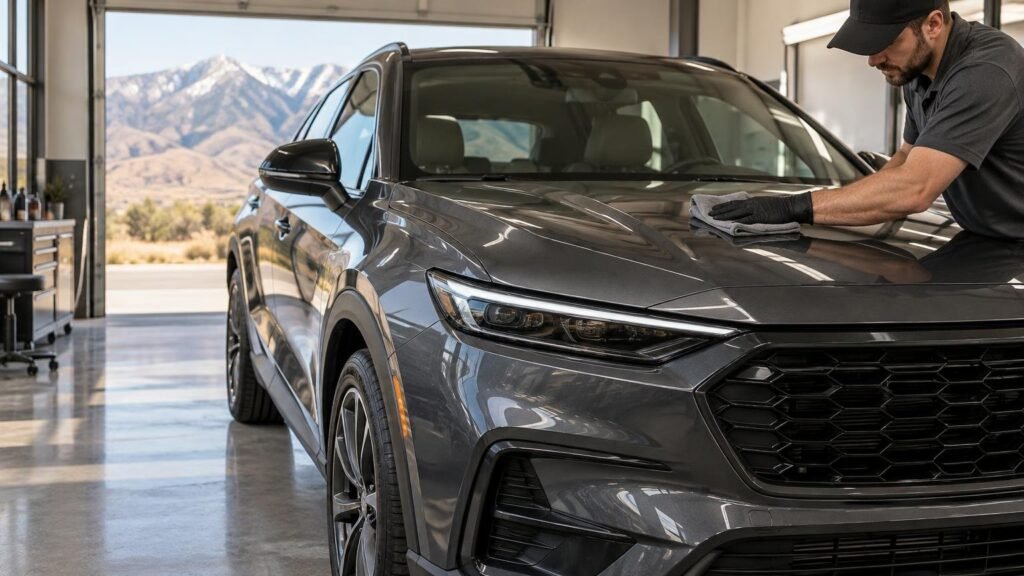
The practical answer to “how long does PPF last” is not one universal number. Current manufacturer examples span roughly five to 12 years of limited warranty coverage or stated designed service, depending on the named product. The film on a particular vehicle may need attention sooner because of installation problems, heavy exposure, poor care, or impact damage. It may also remain presentable and protective for years when correctly installed and maintained.
A better way to estimate PPF life is to identify the exact film, read its current warranty and care instructions, and inspect its condition over time. Utah freeway mileage, canyon travel, outdoor parking, winter contamination, construction debris, and recreational use can change the exposure, but none of those factors produces a reliable countdown on its own.
Warranty length is not the same as usable PPF life
Manufacturers publish different terms for different products. SunTek says its professionally installed PPF products are designed to last from at least five years to as long as 12 years, depending on the selected film. Its published materials list a five-year limited warranty for Clear and Matte, 10 years for Ultra, and 12 years for Reaction. Avery Dennison’s North American documentation likewise lists product-specific periods, including 10 years for Supreme Defense Gloss and seven years for Supreme Defense Matte and neo noir.
Those examples show why “PPF lasts 10 years” is too broad. Products from the same manufacturer can carry different terms, and warranty documents usually include eligibility rules, exclusions, care requirements, and claim procedures. Ask for the precise product name rather than accepting a brand-level statement.
A limited warranty also does not promise that film will look flawless or stop every impact for the entire term. For example, 3M states that ordinary wear and physical-impact damage from rocks or road debris are outside its PPF limited warranty coverage. A film can be functioning normally yet acquire impact marks, and one severe strike can puncture otherwise healthy film.
| Question | What it actually tells you |
|---|---|
| What is the manufacturer warranty term? | How long specified defects may be covered when the product, installation, care, registration, and claim satisfy the written terms. |
| How old is the film? | A useful starting point, but not a complete condition assessment. |
| What does the film look like now? | Whether lifting, cracking, staining, punctures, or other changes justify inspection or replacement. |
| How has the vehicle been used and stored? | The amount and type of heat, UV, contamination, abrasion, and impact exposure the film has experienced. |
What affects how long PPF lasts?
The exact film product
PPF products differ in construction, finish, topcoat, warranty, and manufacturer care requirements. Even closely related films should not be assumed to age identically. Keep the product paperwork, installation date, installer information, and any required warranty registration. Without the product name, it becomes harder to select compatible cleaners, interpret a defect, or determine whether a claim may qualify.
Installation and the condition of the paint
Film performs best when installed on a properly prepared, compatible surface. Contamination at an edge, incomplete adhesion, difficult panel geometry, or an unsuitable painted surface can create problems that are not ordinary film aging. Avery Dennison’s warranty materials exclude improper installation as well as improper or abrasive care.
Previous bodywork matters too. LLumar describes PPF as intended for original painted surfaces and notes that fresh paint commonly needs about 30 days to outgas before installation. Refinish systems and body-shop instructions vary, so the paint provider and PPF installer should confirm readiness rather than relying on 30 days as an automatic rule.
UV, heat, and vehicle storage
A vehicle parked outdoors experiences a different environment from one usually stored in a garage. Sun exposure, heat cycles, airborne contamination, and weather act on the film repeatedly. 3M advises keeping a film-covered vehicle indoors, in shade, or under a cover when possible to help protect it from heat and UV exposure. Garage storage cannot guarantee a particular lifespan, but reducing unnecessary exposure is a sensible way to support the film’s condition.
Panel orientation and exposure
Hoods, roofs, and trunk lids receive direct overhead exposure, while bumpers, mirrors, rocker panels, and lower doors face different combinations of road debris and contamination. Doors and quarter panels may receive fewer direct front-end strikes but can still be affected by parking contact, vegetation, cargo, or winter grime.
There is no responsible universal rule that horizontal PPF always fails a fixed number of years before vertical PPF. Instead, inspect panels according to their actual exposure. On a high-mileage Utah vehicle, the bumper and hood may deserve closer impact inspection, while a vehicle parked outside may warrant particular attention across exposed upper surfaces.
Washing, contaminants, and edge care
Care begins immediately after installation, but post-install wash instructions are product-specific. Avery Dennison says to wait 48 hours, while LLumar and SunTek advise approximately three days or 72 hours. Follow the instructions supplied for the installed film instead of applying one brand’s timing to another product.
After that initial period, use clean, gentle wash tools and products compatible with the film. SunTek recommends hand washing and warns that automatic washes and power washing may lift film. 3M advises avoiding abrasive cleaning tools and cleaning fuel spills promptly. If pressure washing is permitted by the applicable care guide, avoid directing concentrated pressure toward film edges. Do not scrub stubborn contamination aggressively just because ordinary washing did not remove it.
Utah winter grime still needs routine removal. PPF covers painted surfaces, not the undercarriage or every seam, and it does not eliminate ordinary cleaning. The distinction is explained further in this guide to road salt and PPF in Utah.
Self-healing does not reset damaged film
Some named PPF products have self-healing topcoats intended to reduce certain light surface scratches with heat. SunTek describes this behavior for Ultra while separately describing the film as protection against rocks and road debris. These are not interchangeable promises: a feature that addresses shallow surface marks does not repair a puncture, deep cut, missing material, damaged paint, or every rock strike.
A faint wash mark may become less visible under the conditions allowed by the manufacturer. A cut that catches a fingernail, an open puncture, or film crushed by a substantial impact requires inspection instead. For a closer explanation of that boundary, see what self-healing PPF can and cannot repair.
When should PPF be replaced?
Replacement should be based on condition as well as age. Arrange a professional inspection when you notice an edge that continues to lift, persistent or expanding bubbles, cracking, delamination, pronounced yellowing, staining that cannot be removed safely, deep cuts, punctures, or visible damage after an impact. A sudden change deserves attention even when the film is well within its stated warranty period.
Not every defect requires removing all the PPF. If one bumper section or rocker panel has taken the damage while the remaining film is sound, replacing the affected piece may be more sensible than replacing a full-vehicle installation. The installer should also check whether a newly replaced section will create a noticeable difference in gloss, texture, or color beside older film.
Avoid pulling questionable film off at home, especially when it is old, brittle, cold, installed over repaired paint, or difficult to identify. LLumar recommends professional removal, particularly in cold conditions. Paint history, adhesive condition, film age, and technique all influence how predictable removal will be. Read more about PPF removal and factory paint before deciding how to proceed.
Choose coverage with future replacement in mind
Coverage affects maintenance and replacement cost. A partial-front package concentrates protection on exposed areas but may place a visible seam across the hood. Full-front coverage protects the complete bumper, hood, front fenders, and usually mirrors, reducing the need for a mid-panel hood seam. Targeted rocker, door-edge, door-cup, and luggage-area pieces can make sense when those zones receive repeated abrasion. Full-body PPF offers the broadest coverage but also creates more material to inspect and eventually replace.
The right choice is not automatically the largest package. A garage-kept, low-mileage vehicle may have different needs from an I-15 commuter, ski-trip SUV, track car, or truck that regularly encounters gravel. Concentrating the budget on the panels with meaningful exposure can provide a better balance of protection, appearance, and future replacement expense.
What to verify before installation
Ask for written answers to the points that determine what “long-lasting” means for the installation:
- The manufacturer and exact film product, including its finish.
- The current manufacturer warranty, exclusions, registration steps, and whether installation by an authorized party is required.
- Any separate workmanship coverage and which party provides it.
- The required wait before washing and the approved washing, decontamination, and maintenance methods.
- Whether the film is appropriate for original paint, repainted panels, matte paint, or other relevant surfaces on the vehicle.
- How individual damaged panels are evaluated, removed, and replaced.
- Where seams and exposed edges will appear for the selected coverage package.
Keep the invoice and product documentation with the vehicle records. If a later owner or another installer needs to evaluate the film, knowing exactly what was installed is much more useful than knowing only that the vehicle “has PPF.”
Use the film’s condition—not a generic deadline
PPF can deliver multi-year protection, but the credible estimate starts with the named product and its documentation. Warranty examples may range from five to 12 years, yet installation quality, paint condition, storage, UV and heat, washing, contamination, road exposure, and impacts determine what happens on a particular vehicle.
The practical next step is simple: identify the film, follow its care guide, and inspect exposed panels and edges regularly. Replace a damaged section when protection or appearance is materially compromised rather than assuming every panel must remain in place until a warranty anniversary—or that the entire vehicle needs new film because one high-impact panel took a hit.
Frequently Asked Questions
How long does PPF normally last?
There is no universal lifespan. Current manufacturer examples range from five to 12 years of limited warranty coverage or stated designed service, depending on the named film, while installation, exposure, maintenance, and damage affect its actual condition.
Is a 10-year PPF warranty a guaranteed 10-year lifespan?
No. A limited warranty has eligibility rules and exclusions and does not guarantee flawless appearance or protection from every impact. 3M, for example, excludes ordinary wear and physical-impact damage from rocks or road debris.
How long should I wait to wash a vehicle after PPF installation?
Follow the instructions for the installed product. Avery Dennison says to wait 48 hours, while LLumar and SunTek advise approximately three days or 72 hours.
Can self-healing PPF repair rock strikes and deep cuts?
Self-healing features may reduce certain light surface scratches under the manufacturer’s specified conditions. They do not repair punctures, deep cuts, missing material, damaged paint, or every rock strike.
When should PPF be inspected or replaced?
Arrange an inspection for continuing edge lift, persistent or expanding bubbles, cracking, delamination, pronounced yellowing, staining that cannot be removed safely, deep cuts, punctures, or visible impact damage. A damaged section may be replaceable without removing otherwise sound film.
References
- Select the PPF Product and Performance You Need | SunTek
- Paint Protection Film Clear and Matte | SunTek
- Paint Protection Film Ultra | SunTek
- Reaction Paint Protection Film | SunTek
- Paint Protection Film Warranty and Care Information
- Auto Films – Official 3M Support
- Paint Protection Film Frequently Asked Questions | LLumar
- 3M | How To Protect Your Vehicle after Tinting, PPF or Wrapping?
- Answers to your Paint Protection Film Questions | SunTek